Eat a healthy diet. This means eating plenty of fruits, vegetables, whole grains, and lean protein. It also means limiting unhealthy foods like processed foods, sugary drinks, and saturated and trans fats.
Get regular exercise. Aim for at least 150 minutes of moderate-intensity aerobic activity or 75 minutes of vigorous-intensity aerobic activity each week.
Maintain a healthy weight. A healthy weight is important for your overall health and can help reduce your risk of chronic diseases like heart disease, stroke, type 2 diabetes, and some types of cancer.
Get enough sleep. Most adults need around 7-8 hours of sleep per night.
Manage stress. Stress can take a toll on your physical and mental health. Find healthy ways to manage stress, such as exercise, relaxation techniques, or spending time with loved ones.
Don't smoke. Smoking is one of the leading causes of preventable death. If you smoke, quitting is the best thing you can do for your health.
Limit alcohol consumption. Alcohol can have negative health effects, especially if you drink too much. If you choose to drink alcohol, do so in moderation.
Get regular checkups. See your doctor for regular checkups, even if you feel healthy. This is important for catching any health problems early on.
Get vaccinated. Vaccinations can help protect you from serious diseases like measles, mumps, rubella, and influenza.
Avoid harmful substances. This includes exposure to secondhand smoke, asbestos, and certain chemicals.
Take care of your mental health. Just like physical health, mental health is important for overall well-being. If you are struggling with your mental health, seek professional help.
Live a balanced life. It is important to find a balance between work, rest, and play. Make time for the things that you enjoy and that make you feel good.
x
These are just a few of the best health tips for life. By following these tips, you can improve your overall health and well-being and reduce your risk of chronic diseases.
Here are some additional tips that may also be helpful:
Following these health tips can help you live a long, healthy, and fulfilling life.
The presence of Artificial intelligence (AI) in the Education Market is significant, as demonstrated by its valuation of $4 billion in 2022. The integration of Intelligent Tutoring Systems (ITS) in the learning process and the growing partnerships with education content providers are among the key drivers contributing to this growth.
AI has emerged as a powerful tool that has the potential to transform the education sector by improving the effectiveness, efficiency, and accessibility of learning. Yes, like any innovation, the penetration of AI in the Education Market has both positive and negative impacts.
In this blog, we’ll examine the effects of AI on education—both good and bad—and their ramifications.
Positive Effects of AI on the Education Sector
1. Increased Focus On Personalized Learning
Personalized learning, gaining popularity for motivating and engaging students, is one of the primary benefits of artificial intelligence in the education sector.
AI systems monitor students‘ progress, spot their weak points, and offer tailored learning resources and suggestions. It has been discovered that customized learning, which allows students to study at their own pace, improves academic performance.
2. The power of Organized Information
AI provides the advantage of organized information, allowing students to access knowledge from various sources effortlessly. With AI-powered systems, educational platforms can efficiently categorize and present information, enabling students to find relevant resources quickly and enhancing their learning experiences.
For example,
In business, organizing customer data allows for targeted marketing campaigns and personalized customer experiences.
In education, organizing course materials and resources enhances learning outcomes.
In personal life, organizing schedules and tasks increases productivity and reduces stress.
Overall, organizing information empowers individuals and organizations to operate more effectively and achieve their goals efficiently.
3. Empowering Students with Special Needs
Artificial intelligence offers unparalleled adaptability in catering to the unique needs of students. By leveraging AI, individualized learning experiences are tailored to each student’s pace, providing invaluable one-on-one attention.
Some AI-powered tools aiding people with special needs include Microsoft Translator, an AI assistive device for deaf learners; Lookout by Google, a tool for visually impaired individuals; Speechify Text Reader, designed for people with dyslexia, ADHD, and low vision; and IFTTT, an automation app.
4. Advanced Educational Quality and Academic Standards
Artificial intelligence offers a cutting-edge approach to enhance student engagement across all educational levels. Through interactive learning methods beyond traditional institutions, AI can dynamically alter course content, provide instant feedback, and gauge student involvement.
AI enriches teaching methodologies by providing students with a unique educational experience. Students can access resources beyond the classroom and receive real-time feedback through AI interactions, unlocking new possibilities for learning and growth.
5. Enhanced Learning Experience
To make learning more fascinating and engaging, AI technology offers immersive and interactive learning experiences like virtual reality and augmented reality. In a safe and regulated atmosphere, students can participate in simulations and real-world situations, which can help them better learn and remember subjects.
For instance, children studying biology could explore the inside of a cell or witness the process of photosynthesis in a virtual lab, providing a more engaging and memorable learning experience.
6. Increased Accessibility
AI technology is an equalizer as it removes barriers such as socioeconomic status, geographic location, and disability. Young learners, regardless of their backgrounds or locations, can access all educational opportunities thanks to AI-powered learning tools.
For instance, students can study a new language at their own pace and without the help of an instructor using AI-powered language learning apps.
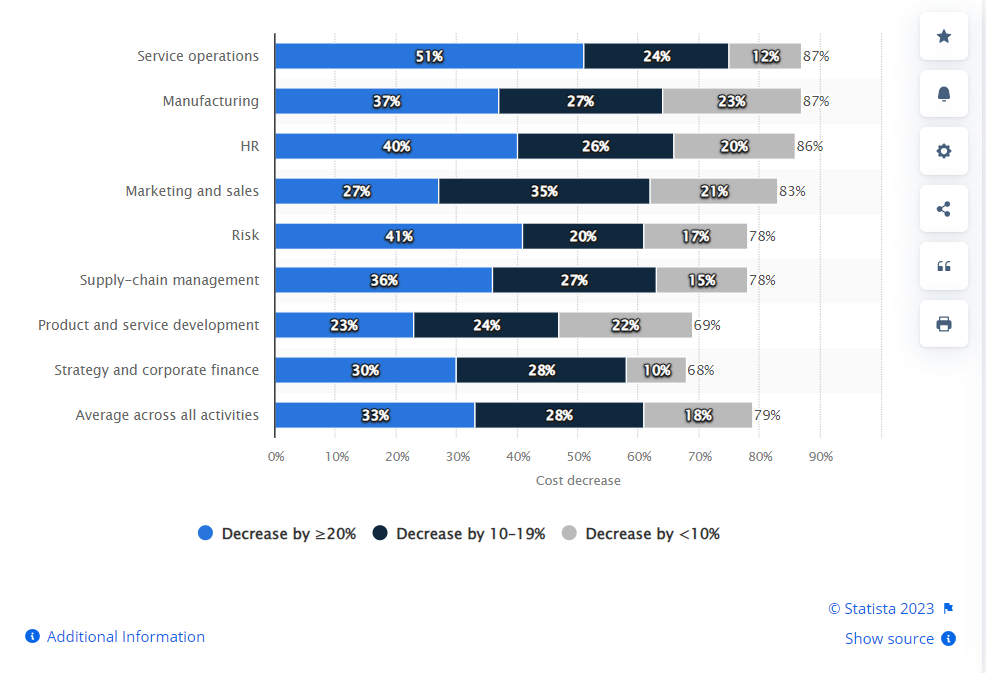
7. Cost Savings
Another benefit of AI is cost-effectiveness. Yes, technology can lower the cost of education by automating difficult tasks and facilitating customized instruction for every student.
This may lessen the need for tutors and teachers, saving time and money for both students and educational institutions.
Image: Cost decreases from adopting artificial intelligence (AI) in organizations worldwide as of fiscal year 2020 by function
Negative Impact of AI on the Education Industry:
1. Job Displacement
One of the biggest concerns about AI’s involvement in education is the potential job displacement of teachers and educators. AI-powered tools can replace important tasks teachers perform, such as grading and providing feedback. This could impact the demand for teachers, resulting in job losses.
2. Emotional Intelligence Limitations
The lack of emotional intelligence plays a crucial role in learning and studying for many individuals. While AI technology has its merits, it should only partially replace teachers, as they offer more than just information. AI is still in its early stages of development regarding human interaction and personal connections, making it essential to maintain the invaluable role of human educators in the learning process.
3. Bias and Inequality
Biased AI algorithms may lead to inequality and discrimination. For instance, AI-driven admissions processes might bias against particular student groups based on their socioeconomic situation or family background.
Similarly, grading algorithms based on AI might be prejudiced against particular types of responses or writing styles.
4. Privacy and Security
AI-powered learning systems gather a wide range of student information, including their behavior, learning progress, and personal data. Cyberattacks and data breaches could endanger students’ security and privacy if this data is exposed. Unauthorized access to AI systems can cause serious security issues impacting students’ lives.
5. Dependence on Technology
The use of AI-powered learning tools requires access to modern technology, including computers, smartphones, and the Internet.
This could lead to a greater dependence on technology, potentially resulting in a decrease in critical thinking and problem-solving skills.
6. Maintenance Challenges
Regarding artificial intelligence in education, there are several drawbacks related to maintenance. It is crucial for authorities to closely monitor AI systems, as they operate based on a finite body of knowledge and can have unintended consequences if pushed beyond their capabilities. Different AI machines may also have incompatible languages, leading to coordination issues and rendering them non-functional at critical times.
Despite these challenges, we have explored the extensive advantages of artificial intelligence in education and its potential for transforming the educational landscape.
Implications of AI on the Education Industry
The effects of AI on education are extensive and complex, with implications dependent on its creation, application, and management.
How to balance it out?
1. Need for Regulation
Regulation of AI research and application in education is necessary to guarantee its moral and responsible application. Regulations should cover topics like prejudice, privacy, and security and make sure that all students may use AI-powered learning tools. But on the other hand, there should be control over students’ use of AI.
2. Collaboration between AI and Teachers
AI should be used to support teachers instead of replacing them in the classroom. For individualized instruction and feedback, teachers should collaborate with AI-powered learning technologies. Smart classes should be installed, and students should be familiarized with them.
3. Investment in Infrastructure
A considerable investment in infrastructure, such as computers, smartphones, and the internet, is required to ensure all students can access AI-powered learning tools. It is important to direct this investment towards disadvantaged students to avoid leaving them behind in the digital divide.
4. Lifelong Learning
AI-driven learning systems can encourage lifelong learning by enhancing accessibility and personalization of instruction. However, to stay up with the quickly changing technological scene, both educators and students need to upgrade their knowledge and skills consistently.
5. Ethical and Social Implications
Guidance on the ethical and societal implications of AI development and implementation in education is necessary. It includes tackling issues like bias, privacy, and security and ensuring that AI-powered learning tools encourage inclusivity and diversity.
6. AI Trends in Education
According to the research, the following are the major trends in AI in education:
The popularity of platforms for personalized learning and adaptive learning is increasing.
The use of chatbots and virtual assistants is growing in educational institutions.
Grading and assessment using AI is becoming more popular.
Gamification and simulation are being used more and more in education.
Conclusion
By providing personalized, accessible, and effective learning experiences, AI has the potential to revolutionize the education sector. However, educators, policymakers, and technology developers must work together to ensure that AI-driven learning tools are used ethically and responsibly.
In conclusion, all stakeholders in education need to recognize these issues and strive to implement ethical and responsible AI practices. Ultimately, striking a balance between the benefits AI can provide and the ethical concerns it raises will be essential for successfully integrating AI in education.
Moonpreneur is on a mission to educate and ignite the flames of entrepreneurship through our holistically created online STEM programs, which will help kids master the futuristic sciences such as Robotics, Game Development, App Development, Advanced Math, and much more!!
Until recent years, Nepal has followed a three-tier education system, 12 years of school education, 4 years of college education and 2 for the master's program. Due to the current political situation of the country, lack of good governance and carelessness of policy makers, our education system is of poor quality, especially in the public sectors. The current scenario of higher education doesn't depict a clear road map for the personal development of the students & the development of the country. So the time has come to update our education with latest technology and learning procedure in order to produce globally competent human resources.
The most important thing that has to be improved is the syllabus which should be focused on fundamental understanding of the subject matter & increase critical thinking and problem abilities of the students. Classroom-based education should be replaced by field based and practical based system. Instead of paper based examinations, quality evaluation techniques should be applied. There is a direct relationship between education and sustainable development, so government should invest more in education and it should be prioritized.
CHINTAN PATHAK
BSC SCIENCE, TRIBHUVAN UNIVERSITY
What is education? Let us just first know the literal meaning of it. “Education is the process of facilitating learning, or the acquisition of knowledge, skills, values, beliefs, and habits. Educational methods include storytelling, discussion, teaching, training, and directed research. Education frequently takes place under the guidance of educators, but learners may also educate themselves. Education can take place in formal or informal settings and any experience that has a formative effect on the way one thinks, feels, or acts may be considered educational.”
I and many of us only think that education is through teaching. But teaching is only one dimension for educating someone. Where are storytelling, training and other?
These all dimensions should be carried out or say implemented simultaneously. You go to school listening to your teacher or instructors, do their work and then return home. We are perceiving education by only this means. We are not awakened. Please wake up, the major part of education technology is not enforced properly. Hence, I say we should give equal weight to research, training, and storytelling and most important are educating yourself by you.
ANANDA WAGLE
PRIME COLLEGE
In the 21st Century, education is the fundamental need for all. Education system should be task oriented, not only the theory education but should be practical as well, for example, if I have the knowledge of Digital Logic, I am able to make electronic torch. I mean this sort of knowledge directly sales at market, the individual survive with self-dependent skills, and same as this each and every people have different skills in different sectors. Here we can create better job inside the country then the outcome would be make our country great independent. To improvement education system the policy maker must be a Ph.D. holder on Education Policy Management System. Staff recruitment process shouldn’t be based on political process and emphasis on knowledge, skills, and expertise.
SANTOSH SAPKOTA
SIKKIM MANIPAL UNIVERSITY
Nepal has a formal education structure. A primary school has an official entry age of 5 and duration of 5 grades, secondary which consists of grades 6-12 is further divided into 3 levels: lower secondary (grades 6-8), secondary (grades 9 & 10) and higher secondary (grades 11 & 12). Also, further high levels have been well established at present which includes bachelor level, master’s degree.
The education system in Nepal has been well developed in the urban areas whereas in remote areas still, we need to put lots of effort for the improvement of education.
The term education policy means the principles and government policy-making in the educational sphere as well as the collection of laws and rules that govern the operation of education systems.
Policies like quality in education, research-oriented education system, education that will produce manpower competent enough to manage in the international scenario, introducing the use of science and technology in teaching methods are the principal policies that are needed to be introduced in our education system.
The quality of education in a country determines the quality of human resources in that country. Along with the previous education policies, the school size, class size, teaching methods, education to every single citizen of the country without the discrimination in gender, caste, religion, status, school infrastructure are also to be included in the policies for the improvement of the education system
MALIKA SHRESTHA
PUBLIC YOUTH CAMPUS
Regarding self, as a part of an innovative society, each bud of flower should have equal rights to bloom, flourish and spread. No flower should be limited within a tiny pot but should get enough of wide premises with no any boundaries for the curiosity. Following the history of education policy in Nepal, we have been involved much unto the theories and certificates of higher grades. No one ever gets an opportunity to acknowledge the learning within the self. The process of learning should be interesting, practical-based and skills oriented rather than the bundles of words forcefully been set into the tender minds. Peaceful environment using latest teaching materials preferably online-based: E-books/library, The PowerPoint presentation and the Art of visualizing are the valuable assets for the betterment. All possible ideas and technologies should be united to create a renewable education source. Our wide concern should be more focused on creativity and the goals to make every student a lifelong learner with strong basic academic qualification. Environment and the people should be the platform to explore the authenticity of knowledge gaining. No students should ever be tortured to secure good marks but we should more emphasis on their will power and inner desire. At last but not the least, Einstein knows it better 'Everyone is born a genius but if you judge a fish on its ability to climb a tree, you will live your whole life believing it's stupid.'
ANGEL PUDASAINI
TRI CHANDRA MULTIPLE CAMPUS
2073/2074 is the year where the education system has been changed completely. SLC got dissolved arising SEE and the students will now get their school leaving certificate after successfully passing out Grade 12 only. It doesn’t matter the changes in examination systems rather the quality of education is more important. Every day we go to schools/colleges and professors/teachers explain the stuff mostly mark oriented knowledge which is not all sustainable. That’s why the population of the students gets on decreasing till they reached the higher levels. Actually, if the base is not so strongly made, sooner or later it will fall; similarly, it applies in the education system also. Government-supplied teachers are frequently of poor quality and alleged to corruption. And still students are studying in such an environment and this is the reason why we are not so competitive compared to international students. The government might take an excuse of being developing country for not being able to support educational infrastructures but it’s high time for Government to take a right chord in terms of policies, budgetary allocations, and sets of priorities for the better education system in Nepal.