The presence of Artificial intelligence (AI) in the Education Market is significant, as demonstrated by its valuation of $4 billion in 2022. The integration of Intelligent Tutoring Systems (ITS) in the learning process and the growing partnerships with education content providers are among the key drivers contributing to this growth.
AI has emerged as a powerful tool that has the potential to transform the education sector by improving the effectiveness, efficiency, and accessibility of learning. Yes, like any innovation, the penetration of AI in the Education Market has both positive and negative impacts.
In this blog, we’ll examine the effects of AI on education—both good and bad—and their ramifications.
Positive Effects of AI on the Education Sector
1. Increased Focus On Personalized Learning
Personalized learning, gaining popularity for motivating and engaging students, is one of the primary benefits of artificial intelligence in the education sector.
AI systems monitor students‘ progress, spot their weak points, and offer tailored learning resources and suggestions. It has been discovered that customized learning, which allows students to study at their own pace, improves academic performance.
2. The power of Organized Information
AI provides the advantage of organized information, allowing students to access knowledge from various sources effortlessly. With AI-powered systems, educational platforms can efficiently categorize and present information, enabling students to find relevant resources quickly and enhancing their learning experiences.
For example,
In business, organizing customer data allows for targeted marketing campaigns and personalized customer experiences.
In education, organizing course materials and resources enhances learning outcomes.
In personal life, organizing schedules and tasks increases productivity and reduces stress.
Overall, organizing information empowers individuals and organizations to operate more effectively and achieve their goals efficiently.
3. Empowering Students with Special Needs
Artificial intelligence offers unparalleled adaptability in catering to the unique needs of students. By leveraging AI, individualized learning experiences are tailored to each student’s pace, providing invaluable one-on-one attention.
Some AI-powered tools aiding people with special needs include Microsoft Translator, an AI assistive device for deaf learners; Lookout by Google, a tool for visually impaired individuals; Speechify Text Reader, designed for people with dyslexia, ADHD, and low vision; and IFTTT, an automation app.
4. Advanced Educational Quality and Academic Standards
Artificial intelligence offers a cutting-edge approach to enhance student engagement across all educational levels. Through interactive learning methods beyond traditional institutions, AI can dynamically alter course content, provide instant feedback, and gauge student involvement.
AI enriches teaching methodologies by providing students with a unique educational experience. Students can access resources beyond the classroom and receive real-time feedback through AI interactions, unlocking new possibilities for learning and growth.
5. Enhanced Learning Experience
To make learning more fascinating and engaging, AI technology offers immersive and interactive learning experiences like virtual reality and augmented reality. In a safe and regulated atmosphere, students can participate in simulations and real-world situations, which can help them better learn and remember subjects.
For instance, children studying biology could explore the inside of a cell or witness the process of photosynthesis in a virtual lab, providing a more engaging and memorable learning experience.
6. Increased Accessibility
AI technology is an equalizer as it removes barriers such as socioeconomic status, geographic location, and disability. Young learners, regardless of their backgrounds or locations, can access all educational opportunities thanks to AI-powered learning tools.
For instance, students can study a new language at their own pace and without the help of an instructor using AI-powered language learning apps.
7. Cost Savings
Another benefit of AI is cost-effectiveness. Yes, technology can lower the cost of education by automating difficult tasks and facilitating customized instruction for every student.
This may lessen the need for tutors and teachers, saving time and money for both students and educational institutions.
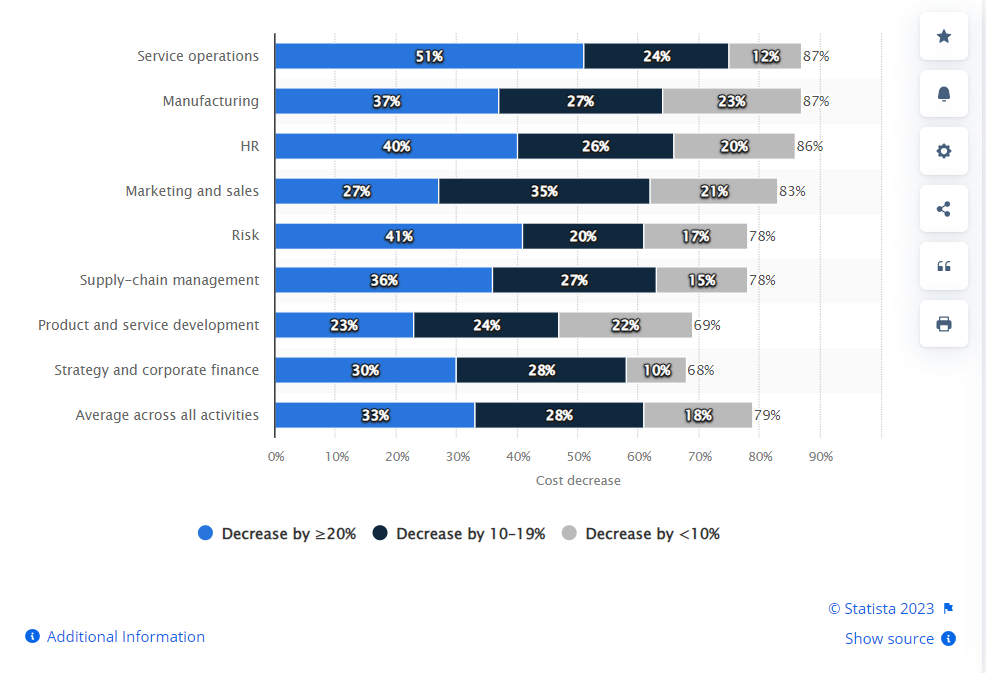
Image: Cost decreases from adopting artificial intelligence (AI) in organizations worldwide as of fiscal year 2020 by function
Negative Impact of AI on the Education Industry:
1. Job Displacement
One of the biggest concerns about AI’s involvement in education is the potential job displacement of teachers and educators. AI-powered tools can replace important tasks teachers perform, such as grading and providing feedback. This could impact the demand for teachers, resulting in job losses.

2. Emotional Intelligence Limitations
The lack of emotional intelligence plays a crucial role in learning and studying for many individuals. While AI technology has its merits, it should only partially replace teachers, as they offer more than just information. AI is still in its early stages of development regarding human interaction and personal connections, making it essential to maintain the invaluable role of human educators in the learning process.
3. Bias and Inequality
Biased AI algorithms may lead to inequality and discrimination. For instance, AI-driven admissions processes might bias against particular student groups based on their socioeconomic situation or family background.
Similarly, grading algorithms based on AI might be prejudiced against particular types of responses or writing styles.
4. Privacy and Security
AI-powered learning systems gather a wide range of student information, including their behavior, learning progress, and personal data. Cyberattacks and data breaches could endanger students’ security and privacy if this data is exposed. Unauthorized access to AI systems can cause serious security issues impacting students’ lives.


Source: moonpreneur


No comments:
Post a Comment